
sf::Thread Class Reference
Thread defines an easy way to manipulate a thread. More...
#include <Thread.hpp>
Inheritance diagram for sf::Thread:
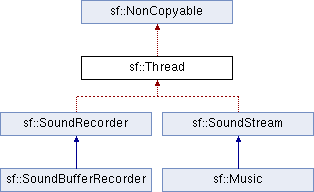
Public Types | |
| typedef void(* | FuncType )(void *) |
Public Member Functions | |
| Thread (FuncType Function, void *UserData=NULL) | |
| Construct the thread from a function pointer. | |
| virtual | ~Thread () |
| Virtual destructor. | |
| void | Launch () |
| Create and run the thread. | |
| void | Wait () |
| Wait until the thread finishes. | |
| void | Terminate () |
| Terminate the thread Terminating a thread with this function is not safe, you should rather try to make the thread function terminate by itself. | |
Protected Member Functions | |
| Thread () | |
| Default constructor. | |
Detailed Description
Thread defines an easy way to manipulate a thread.
There are two ways to use Thread :
- Inherit from it and override the Run() virtual function
- Construct a Thread instance and pass it a function pointer to call
Definition at line 44 of file Win32/Thread.hpp.
Constructor & Destructor Documentation
| sf::Thread::Thread | ( | FuncType | Function, |
| void * | UserData = NULL |
||
| ) |
Construct the thread from a function pointer.
- Parameters
-
Function : Entry point of the thread UserData : Data to pass to the thread function (NULL by default)
|
virtual |
Virtual destructor.
|
protected |
Default constructor.
Member Function Documentation
| void sf::Thread::Launch | ( | ) |
Create and run the thread.
| void sf::Thread::Terminate | ( | ) |
Terminate the thread Terminating a thread with this function is not safe, you should rather try to make the thread function terminate by itself.
| void sf::Thread::Wait | ( | ) |
Wait until the thread finishes.
The documentation for this class was generated from the following file: